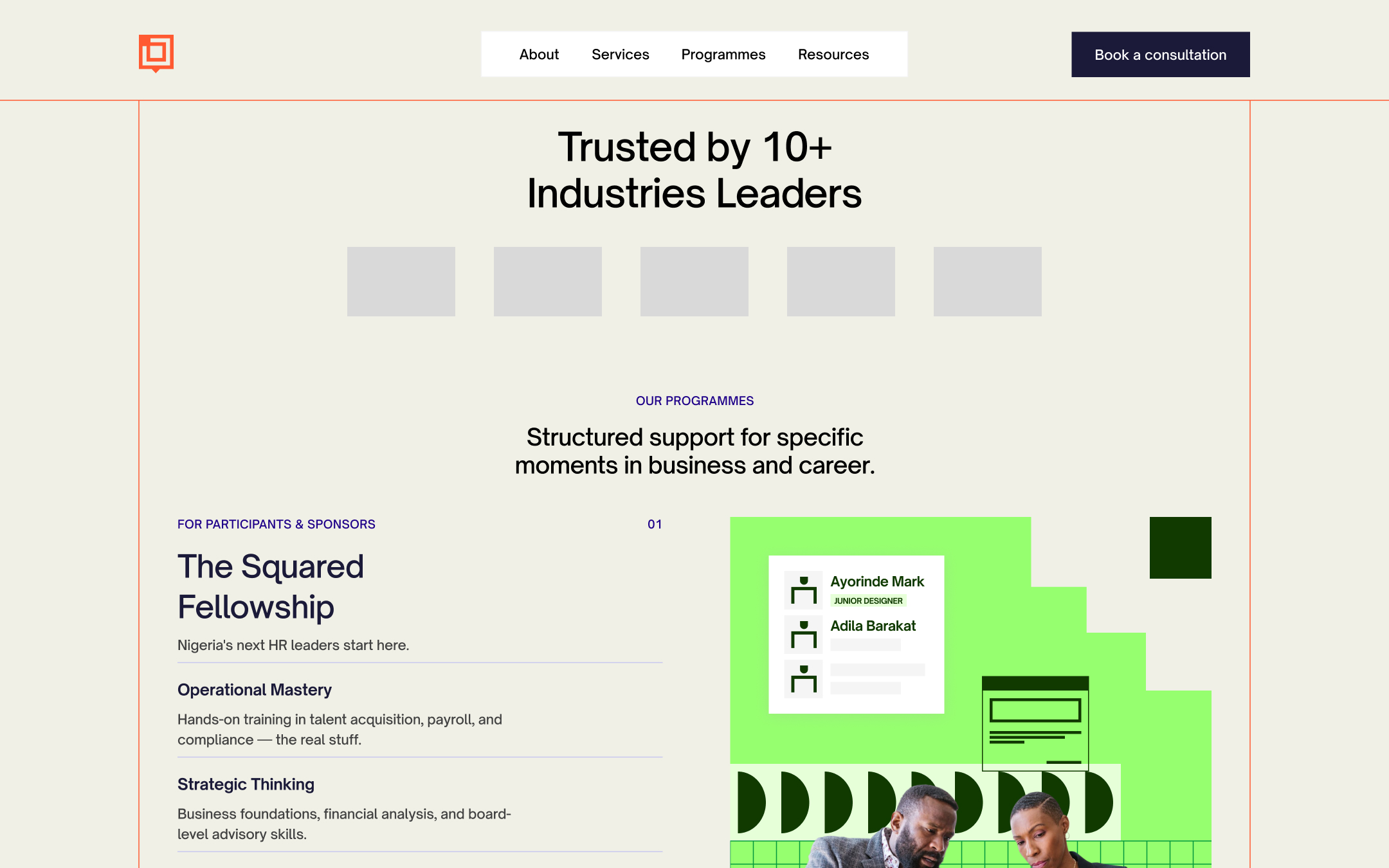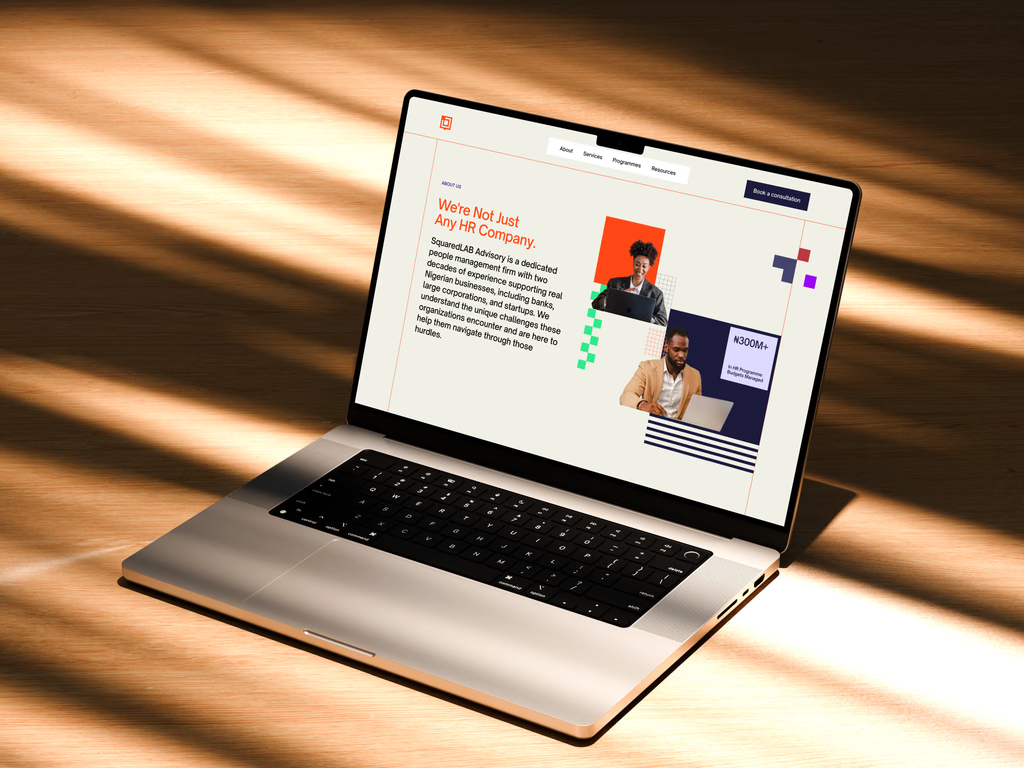
Overview
Making two decades of expertise easier to understand online.
A business can spend years building credibility through its work, relationships, and reputation, yet struggle to communicate that value through its digital presence.
That was the challenge with SquaredLAB Advisory.
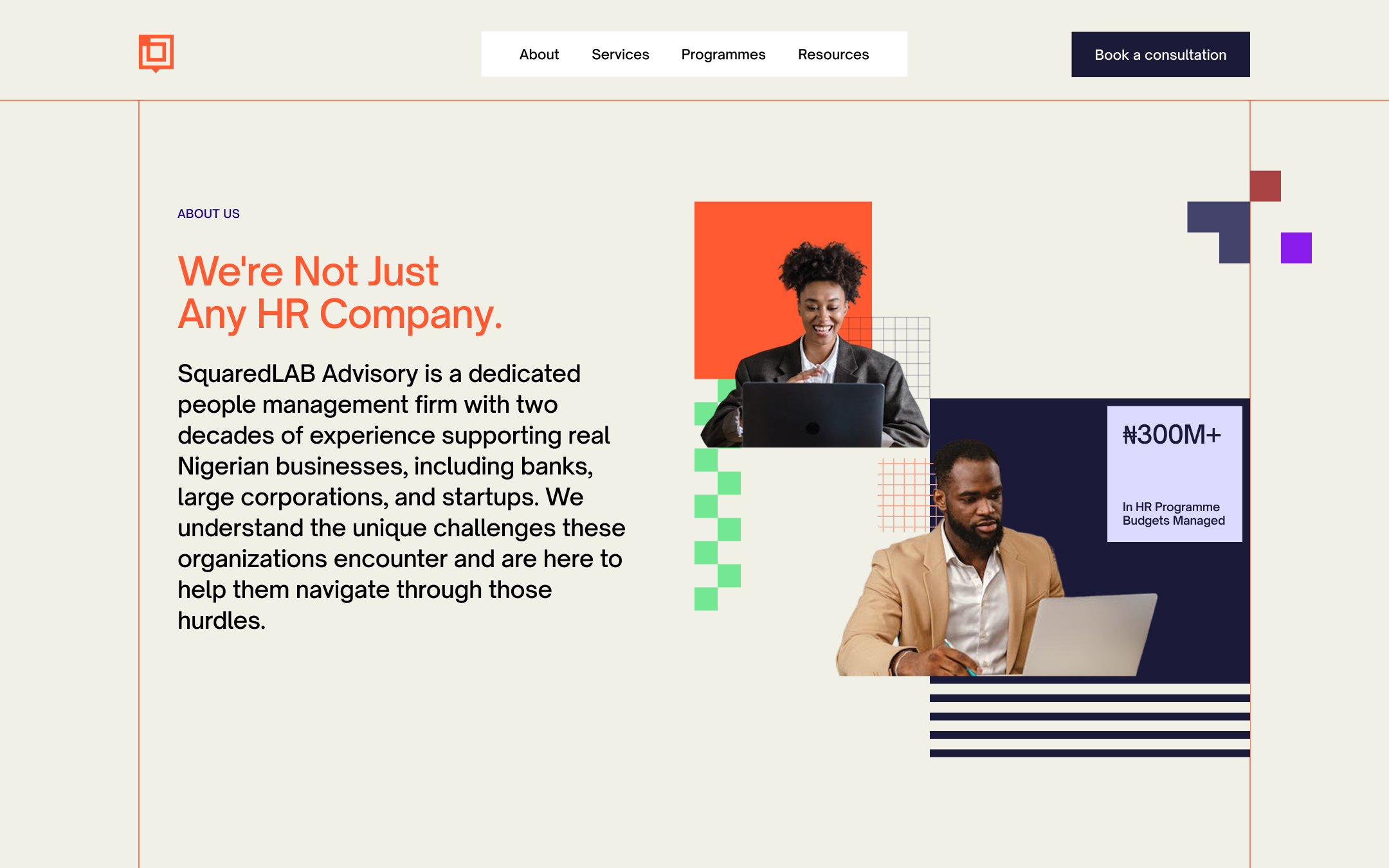
SquaredLAB is an HR consulting and business advisory firm serving African SMEs and established organizations. With over two decades of industry experience, the business had developed expertise across multiple service areas.
However, its digital presence did not adequately communicate the depth of that expertise or make it easy for prospective clients to understand what the firm offered.
Through Parallel Lab, we worked with SquaredLAB to rethink how the business presented itself online.
The engagement went beyond refreshing the website's appearance. It required understanding the business, organizing its services, clarifying its positioning, and translating that thinking into a cohesive digital experience.
My role involved guiding the discovery and strategic direction, coordinating the design and development process, and helping ensure that the final experience supported the client's business objectives.
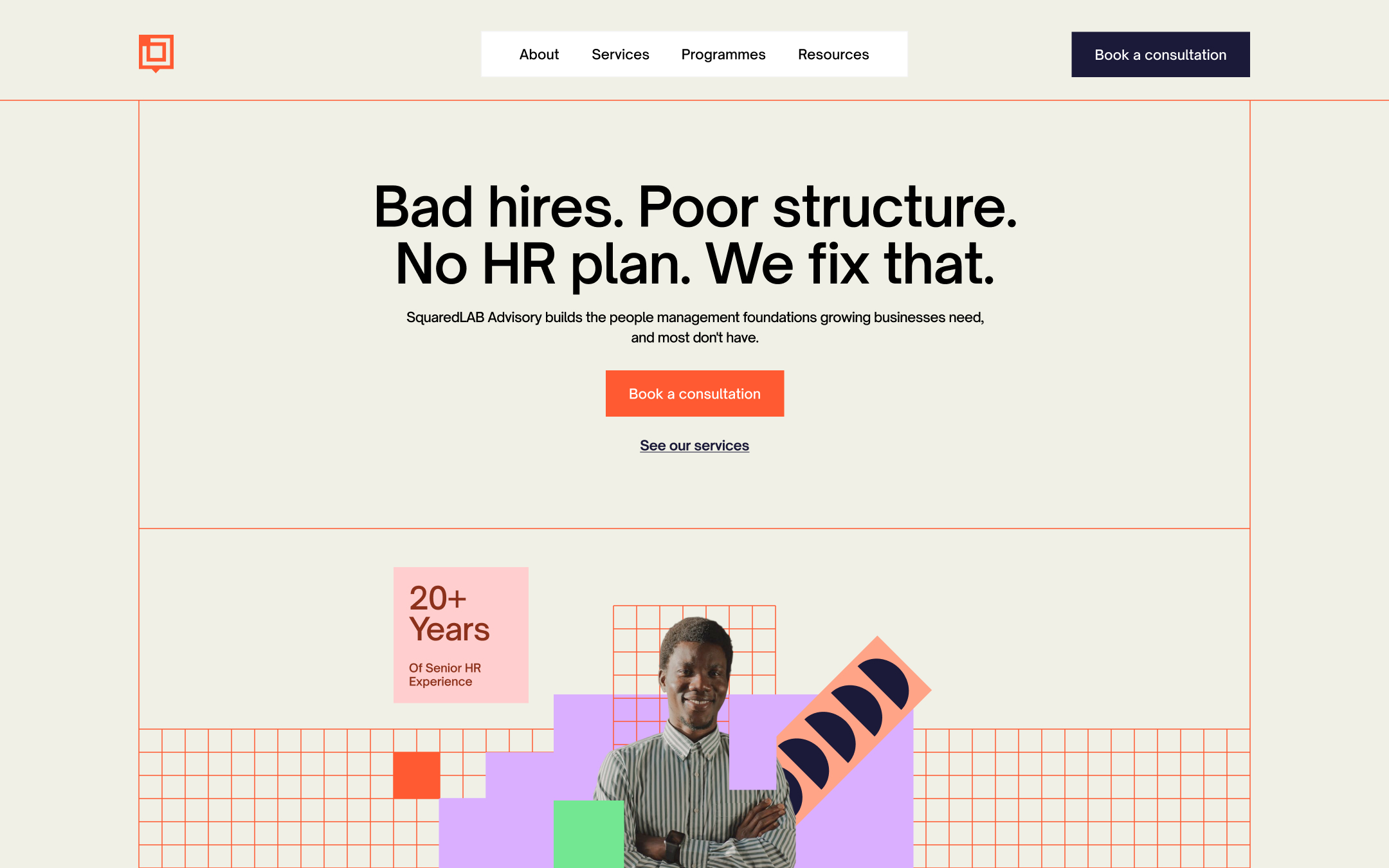
The goal was not simply to create a better-looking website. It was to make a credible business easier to understand, navigate, and trust.
The Challenge
A strong business with an unclear digital presence.
SquaredLAB's challenge wasn't a lack of expertise.
The business already had years of experience, an established service offering, and a clear understanding of the clients it served.
The difficulty was communicating all of that through its website.
Professional services businesses often have complex offerings that don't fit neatly into a single sentence. When those services aren't presented with a clear hierarchy, prospective clients may struggle to understand where to begin.
For SquaredLAB, the digital experience needed to serve business owners, decision-makers, and organizations seeking HR and advisory support.
These visitors needed to understand what SquaredLAB did, determine whether its services were relevant to their needs, and find a clear path toward engaging the firm.
The challenge was therefore both strategic and experiential.
We needed to improve how the business communicated its value without oversimplifying its expertise or overwhelming visitors with information.
Project objectives
01. Clarify the business offering
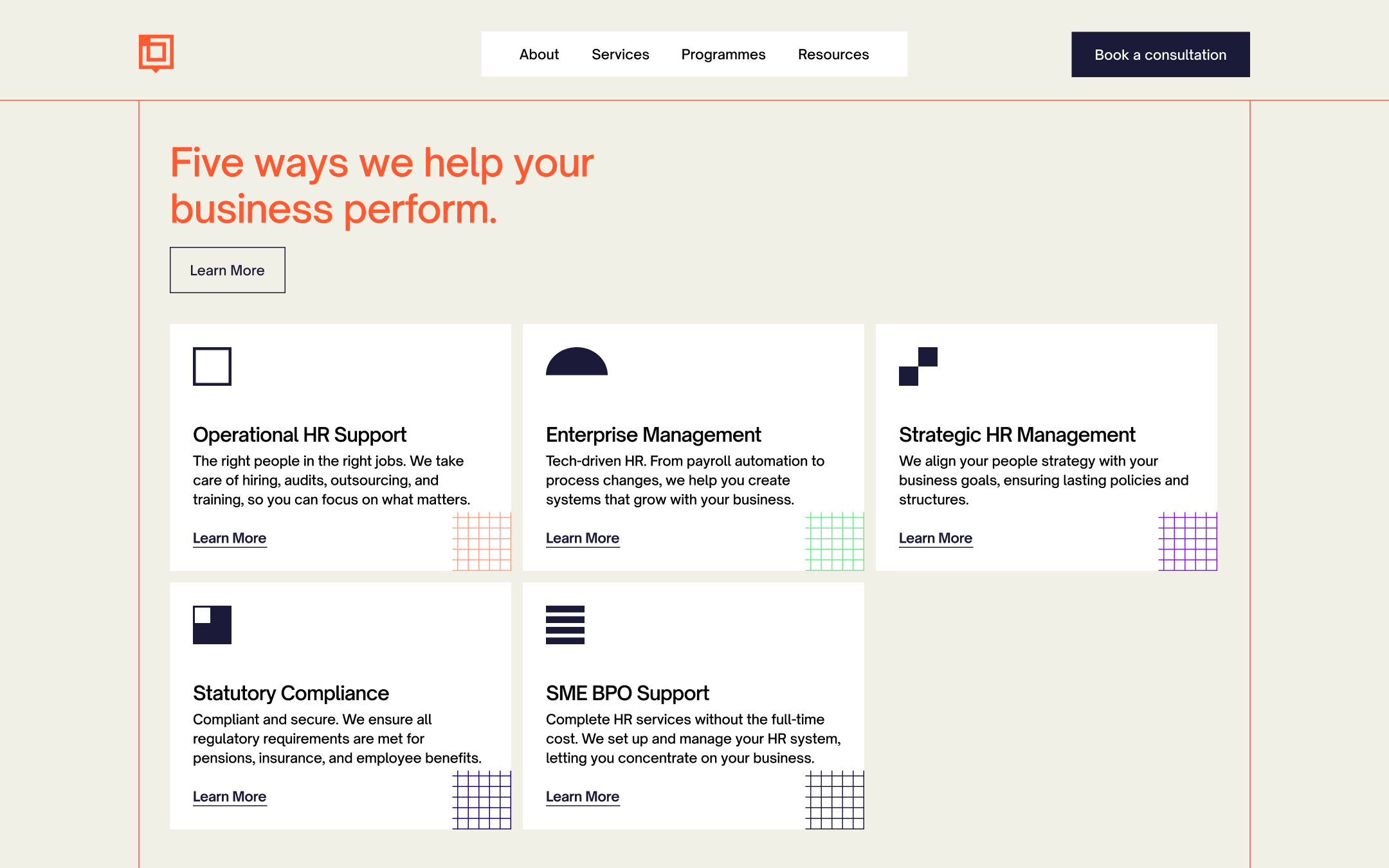
Present SquaredLAB's services in a way that prospective clients could understand without needing extensive prior knowledge of the firm.
02. Strengthen credibility
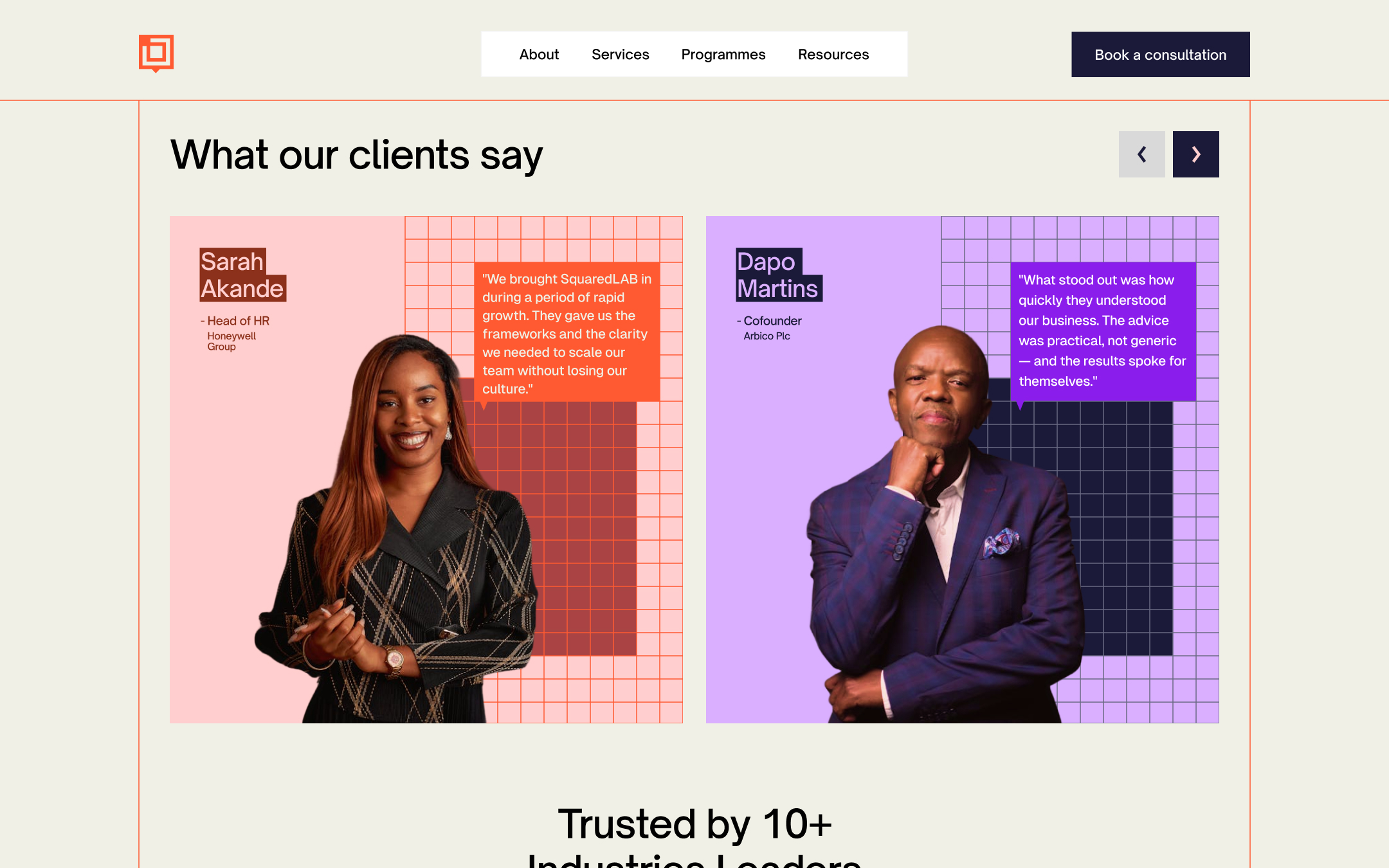
Create a digital presence that reflected the firm's experience, professionalism, and established position in its industry.
03. Improve information hierarchy
Organize the website so that visitors could identify relevant services and navigate the experience with less effort.
04. Support business engagement
Create clearer pathways for prospective clients to learn about the firm and initiate conversations.
05. Build for long-term management
Deliver a website that could support content updates and future business communication without requiring a developer for every routine change.
The central question
How might we translate an established advisory firm's expertise into a digital experience that feels clear, credible, and useful to prospective clients?
My Approach
Understanding the business before designing the website.
I approached the project as a business communication and user-experience challenge rather than beginning with visual exploration.
Before deciding how the website should look, we needed to understand what it needed to communicate.
Stage 01 — Business discovery
The first stage involved understanding SquaredLAB's business, service offering, audience, and objectives for the website.
We explored how the firm described its services, the types of organizations it served, and what prospective clients would need to understand before considering an engagement.
This provided a foundation for evaluating the existing digital experience.
It also helped distinguish between information that was important to the business internally and information that needed to be immediately clear to visitors.
Stage 02 — Industry and competitive research
We examined how other professional services and advisory firms communicated their expertise online.
The objective wasn't to reproduce another firm's website.
Instead, the research helped us understand common expectations around credibility, service presentation, navigation, and calls to action.
We considered how established firms communicated complex offerings without making their websites feel unnecessarily complicated.
These observations informed the direction of the experience.
Stage 03 — Information architecture and content hierarchy
With a clearer understanding of the business, we began organizing the website around the information visitors needed.
This involved considering the relationship between the firm's positioning, services, supporting information, and engagement pathways.
We wanted visitors to move from understanding who SquaredLAB was to identifying relevant services without having to interpret an overwhelming amount of information.
The information architecture became an important part of the design direction.
Rather than treating every piece of content as equally important, we worked toward a structure that gave visitors a clearer sequence of information.
Stage 04 — Design direction and collaboration
Once the business and content direction had been established, the work moved into interface design.
Through Parallel Lab, I coordinated the relationship between the client's requirements, the design work, and the development process.
My responsibility was to help maintain alignment between what the business needed to communicate and how that information was translated into the website.
The visual direction needed to feel professional and credible while remaining approachable and easy to navigate.
This required balancing visual presentation with content clarity and practical usability.
Stage 05 — Development and implementation
The approved direction was translated into a responsive website.
The development work included a content-management system, interactive elements, integrations, and technical considerations supporting the website's functionality.
The implementation used Next.js, React, TypeScript, and Prismic, alongside supporting tools for animation, communications, and payment functionality.
My involvement focused on cross-functional coordination, reviewing delivery against the agreed direction, and managing the relationship between client expectations and implementation.
The engineering implementation was carried out by the development team.
Stage 06 — Review and delivery
As the website progressed, the team reviewed the implementation against the intended experience.
This included checking how content was presented, whether the visual direction remained consistent, and how the website behaved across different screen sizes.
The project moved through a concentrated development and delivery period during June–August 2026.
The result was a completed website experience designed to communicate SquaredLAB's expertise more clearly and support its ongoing digital presence.
Key Product Decisions
Designing for understanding, not just appearance. 01. Start with the business problem
The decision
Begin with business and industry research before moving into visual design.
Why
A more polished website would not necessarily solve the problem if visitors still struggled to understand the firm's offering.
The project needed a clear understanding of the business before visual decisions could be made.
The trade-off
This required more attention to discovery and content structure upfront, rather than immediately producing interface concepts.
It helped establish a stronger rationale for subsequent design decisions.
02. Prioritize clarity over content density
The decision
Organize information according to visitor needs rather than giving every service and message equal prominence.
Why
Professional services businesses often have a lot to communicate.
Presenting everything at once can make it difficult for visitors to identify the information relevant to them.
The trade-off
Some information needed to be introduced progressively rather than appearing immediately.
This allowed the website to communicate its main messages more clearly while still accommodating deeper content.
03. Build credibility through the experience
The decision
Use the website's structure, content presentation, and visual consistency to reinforce the firm's professional credibility.
Why
For an advisory business, trust is central to the decision to engage.
The website needed to reflect the firm's experience without relying solely on decorative visual elements or broad claims.
The trade-off
We prioritized a restrained, purposeful presentation over visual complexity that might distract from the business.
04. Support independent content management
The decision
Use a content-management system to support ongoing website updates.
Why
The website needed to remain useful beyond the initial launch.
Content such as publications and career information could change over time, so routine updates should not depend entirely on engineering support.
The trade-off
This introduced additional implementation considerations around content models, publishing workflows, and maintaining consistency across pages.
05. Balance business requirements with delivery constraints
The decision
Maintain a defined direction and coordinate the work across design, development, and client review.
Why
Client projects involve competing priorities, feedback, and practical delivery limitations.
Without a shared direction, teams can spend time refining individual details while losing sight of the project's main objectives.
The trade-off
Not every possible improvement could receive equal attention.
The focus remained on delivering the agreed experience while protecting the clarity and consistency of the final website.
Evidence of Work
Translating business understanding into a complete digital experience.
SquaredLAB Advisory brought together strategic thinking, design collaboration, and technical execution.
Business and industry research
We examined the firm's positioning, services, target audience, and broader industry context to inform the website direction.
Information architecture
The website structure was developed to help visitors understand the firm, explore its services, and find relevant information.
Design direction
The interface was shaped around professional credibility, clear typography, purposeful layouts, and a consistent visual language.
Cross-functional coordination
I worked across client communication, design direction, development coordination, and review activities to help maintain alignment throughout delivery.
Website implementation
The development team delivered a responsive web experience with 11 routes and a supporting technical architecture.
The implementation included:
Next.js, React, and TypeScript
Prismic content management
Responsive page layouts
Animation and interaction development
Email and payment integrations
Technical SEO and analytics support
Content editing workflows for publications and careers
These engineering deliverables were implemented by the development team as part of the broader Parallel Lab engagement.
Project delivery
The project progressed from discovery and planning through design, implementation, review, and delivery during June–August 2026.
The finished work provided SquaredLAB with a more structured digital platform for communicating its services and supporting ongoing business activity.
Outcome & Reflection
A clearer digital expression of an established business.
The engagement resulted in a completed website experience for SquaredLAB Advisory.
The work brought the firm's positioning, service information, and supporting content into a more deliberate digital structure.
It also introduced a technical foundation for managing content and maintaining the website over time.
For Parallel Lab, the project demonstrated the importance of approaching client websites as business experiences rather than isolated design deliverables.
I don't have verified post-launch conversion, lead-generation, or engagement metrics to report, so I would not attribute specific commercial growth to the redesign.
The documented outcome is the delivery of the new website experience and its supporting content-management and technical capabilities.
What I learned
A website is a business communication tool.
Visual quality matters, but the experience also needs to help visitors understand the business and make decisions.
Discovery creates direction.
Understanding the client's business before designing helped connect creative decisions to actual communication needs.
Information architecture is a strategic decision.
How information is grouped, prioritized, and presented can significantly affect how easily visitors understand a complex service offering.
Good delivery requires alignment.
Client expectations, design decisions, and technical implementation need to remain connected throughout a project.
Product thinking applies beyond software applications.
Even a professional services website involves understanding users, defining problems, prioritizing requirements, making trade-offs, and coordinating delivery.
This project strengthened my ability to connect business objectives with digital experience decisions.
Closing thought
Good digital experiences don't just present a business. They help people understand why that business matters.
SquaredLAB Advisory reinforced my belief that the strongest design decisions begin with understanding the problem.
The result is not simply a website that looks different, but an experience built around clearer communication, stronger structure, and a more deliberate relationship between the business and its audience.
Digital Strategy · Web Experience · Project Delivery · 2026
=====